San José: Museums, Maps, and My Final Day in Costa Rica
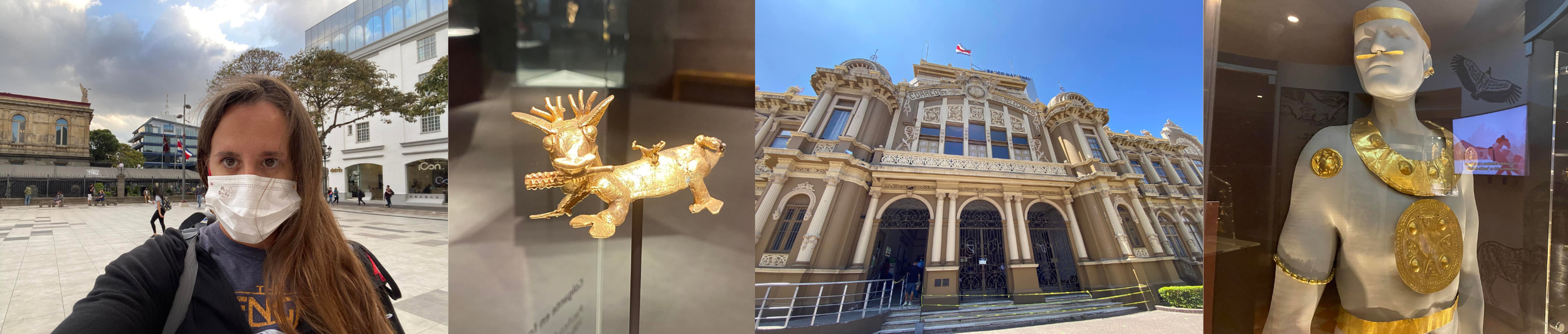
One full day in San José, filled with historic architecture, pre-Columbian gold, and centuries of Costa Rican culture.
Four Nights in Puerto Viejo and the Journey Back to San José
What was originally supposed to be two nights in Puerto Viejo had somehow turned into four.
That was becoming a familiar pattern during my journey through Central America. I would arrive somewhere with a rough idea of how long I planned to stay, only to change my mind once I got there. Puerto Viejo had been an easy place to extend my visit. I had a private room that cost less than many hostel dorms, the beach was only a short walk away, and I had already decided that I wasn’t in the mood for its well-known party scene. Instead, my days became slower—walking through town, spending time near the beach, entertaining my unexpected bird and cat visitors, and simply enjoying having nowhere urgent to be.
Eventually, however, it was time to leave the Caribbean coast and return to San José for my final two nights in Costa Rica.
My bus left Puerto Viejo at around 4:00 p.m. The trip back to San José took approximately four and a half hours, although journeys like that could always take longer depending on traffic. By the time I arrived in the capital, found Hotel El Descanso, checked in, and settled into my room, the day was essentially over.
I hadn’t chosen the hotel because it offered spectacular views, a swimming pool I would inevitably ignore, or an exciting social atmosphere. I had chosen it for one very practical reason: it placed me close to the bus station I would need when I continued into Panama.
By that point, I was roughly five months into my journey through Central America, and convenience had become increasingly valuable. After changing buses, crossing borders, carrying my bags through unfamiliar streets, and repeatedly figuring out how to reach the next destination, sometimes the best accommodation was simply the one that made the following travel day easier.
That meant my first evening in San José was uneventful. Arriving late didn’t leave much opportunity to explore, but I wasn’t particularly concerned. I had one full day in the city, and I planned to make every moment count.
Until then, much of what I had experienced in Costa Rica had revolved around its beaches, forests, wildlife, and outdoor adventures. San José offered me the chance to see another side of the country. I wanted to learn more about its history, culture, and the people who had lived there long before Costa Rica became famous for pura vida. With only one full day available, I decided to fit in as many museums as possible.
Naturally, I would be walking to them.
Walking allowed me to see parts of the city I might otherwise have missed. Before reaching my first museum, I was already stopping to photograph the National Theatre, the Jade Museum, the statue of Juan Mora Fernández, and an old clock standing above a fountain in the square. San José was much busier and more urban than the other places I had visited in Costa Rica, but its historic buildings immediately caught my attention.
My first destination was the National Museum of Costa Rica. I had expected to find exhibits about the country’s past.
I had not expected the visit to begin with butterflies.
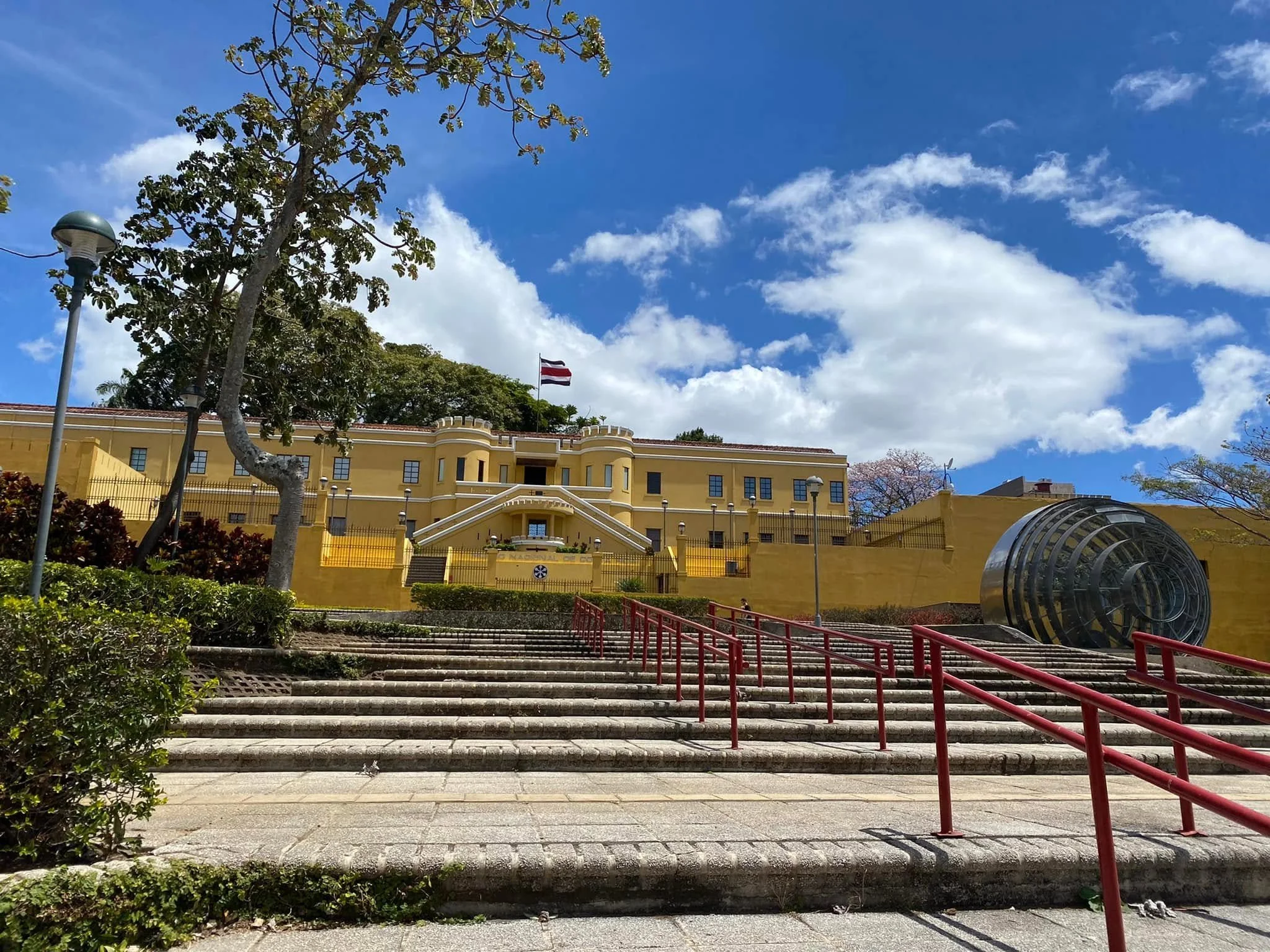
Arriving at the National Museum of Costa Rica, my first major stop during my only full day in San José.
Butterflies, Stone Spheres, and Costa Rica’s Past
The National Museum of Costa Rica was my first major stop of the day, and it ended up being one of my favourite places in San José.
The museum is housed inside the former Bellavista Barracks, a building that holds an important place in Costa Rican history. It was there in 1948 that José Figueres Ferrer symbolically struck the barracks wall following the abolition of Costa Rica’s army. Today, a building once associated with soldiers and weapons has been transformed into a place dedicated to preserving Costa Rica’s history, culture, archaeology, and natural heritage.
Before I reached any of the historical exhibits, however, I entered through the museum’s butterfly garden.
It was an unexpected beginning to a national museum, but a very Costa Rican one. After spending so much of my time in the country surrounded by wildlife, it felt fitting that my final day of sightseeing would begin with butterflies flying freely through a protected garden. One moment I had been surrounded by traffic, pedestrians, and city noise; the next, I was among tropical plants watching butterflies flutter between the leaves.
Once inside the main exhibits, I began learning about how people had lived in Costa Rica over different periods of its history. Displays showed traditional textiles, tools, household objects, and examples of the clothing and jewellery people once wore. Rather than presenting history as a simple timeline of dates and political events, the museum helped me picture everyday life—how people worked, what they made, and how communities changed over time.
I was especially interested in the exhibits explaining how gold objects and jewellery were created. The pieces were incredibly detailed, particularly when considering the tools and techniques available at the time. Gold wasn’t simply used for decoration; many of the objects also represented status, identity, spiritual beliefs, or connections to the natural world. Looking closely, I could recognize shapes inspired by animals and other figures, each carefully formed into something that had survived for centuries.
Then there were the enormous stone spheres.
At first glance, they looked like giant cannonballs placed around the museum grounds. Some were almost perfectly round, which immediately raised the question of how they had been made without modern machinery. Known as the pre-Columbian stone spheres of the Diquís, they were created by Indigenous communities in southern Costa Rica. Their precise purpose is still not completely understood, although they may have been used to mark important locations or demonstrate the status and power of particular settlements.
The museum added another layer to my experience of Costa Rica. Until then, I had known the country mostly through its landscapes and wildlife, but a country is more than the scenery travellers arrive to photograph. By the time I left, I had a better understanding of Costa Rica’s Indigenous history, traditional craftsmanship, and changing ways of life.
My history lesson wasn’t finished. With plenty of daylight remaining, I set out again—this time through San José’s historic centre.

From butterflies and ancient stone spheres to traditional metalworking and weaving, the National Museum revealed another side of Costa Rica.
Walking Through San José’s Historic Centre
Leaving the National Museum, I continued walking through San José’s historic centre with no strict route beyond heading toward my next museum.
This was one of the reasons I preferred exploring cities on foot. Taking a taxi might have been faster, but I would have missed many of the buildings, monuments, churches, and small details that caught my attention along the way. With several hours still available, I could wander, stop whenever something interested me, and take far too many photos without worrying about following a schedule.
The architecture was what first drew my attention. San José didn’t have one consistent appearance. Modern concrete buildings stood beside ornate theatres, historic government buildings, churches, monuments, and public squares. Around one corner, I might find a beautifully preserved façade covered in decorative details. Around the next, I might encounter a McDonald’s, a Pokémon store, or an ordinary commercial building.
Among the most distinctive buildings was Castillo Azul, or the Blue Castle. Its pale blue exterior, curved staircase, arched windows, balconies, and decorative white trim made it look more like an elegant mansion than part of a government complex. Built in the early 1900s, it had once served as a presidential residence and later as the United States Embassy. Today, it forms part of Costa Rica’s Legislative Assembly complex.
Nearby, the fortified walls and old tower of the former Bellavista Barracks created a sharp contrast with Castillo Azul. One building appeared elegant and residential, while the other still carried the heavy, defensive appearance of its military past. Seeing them standing so close together made the area feel like a collection of different chapters from Costa Rica’s history.
As I continued through the city, I passed several churches, including the Metropolitan Cathedral and the Church of Our Lady of Solitude. Their white façades, columns, towers, and carefully shaped details stood out against the blue sky. Even though I wasn’t entering every building I passed, I enjoyed stopping outside and looking at the different architectural styles.
The National Theatre had been one of the first landmarks to make me stop earlier that morning. Its grand stone exterior, arched windows, rooftop statues, iron gates, and decorative entrance made it look almost European. It was exactly the kind of building that made me step back and try to fit the entire façade into a photograph.
The historic Central Post Office was just as striking in a different way. Its elaborate exterior was covered in columns, carvings, balconies, and decorative ironwork. Even the words Correos y Telégrafos remained above the entrance, preserving a reminder of the building’s original purpose.
Yet it wasn’t only the major landmarks that created the atmosphere of the historic centre. I noticed the old clocks standing in the squares and the decorative lamp posts lining the pedestrian areas. Their dark metalwork and traditional designs gave parts of downtown San José an old-time feeling, even while modern businesses, traffic, and crowds carried on around them.
Plaza Juan Mora Fernández was especially lively. Its historic clock stood above a small fountain while pigeons gathered around the water and people crossed the square in every direction. Nearby, the National Theatre overlooked the activity as though it had been watching the city change for generations.
The streets never felt like an outdoor museum frozen in the past. Locals sat around the fountains, met friends, carried shopping bags, ate lunch, and hurried between buildings. That everyday activity made the historic centre feel lived in rather than staged for tourists.
At one point, I tried to photograph the colourful San José sign. Unfortunately, several locals were using the large letters as a convenient shelf for their belongings. I waited and tried again, and I believe I eventually managed to get a photograph without anyone—or their things—covering it. Sadly, that photo was among the images I later lost.
I also passed the entrance to San José’s Chinatown and enough monuments, fountains, and churches to keep my camera busy. I even spotted a Pokémon store among all the historic architecture, because apparently my attention can shift very quickly from national monuments to Pokémon.
By then, I had already packed an impressive amount into my one full day in San José. However, I still had enough time for another museum.
This time, I was heading underground in search of ancient gold, historic currency, and centuries-old maps.
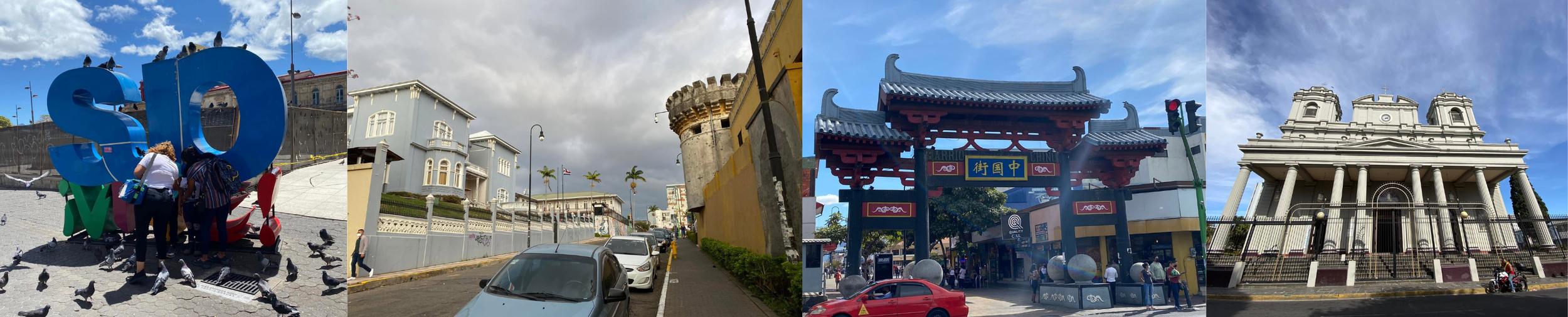
Exploring San José’s historic centre, from its not-quite-photo-ready city sign to Castillo Azul, Chinatown, and the Metropolitan Cathedral.
Ancient Gold, Old Maps, and an Unexpected Movie
My second museum of the day was the Pre-Columbian Gold Museum, hidden beneath Plaza de la Cultura in the centre of San José.
From the busy public square above, it would have been easy to walk past without realizing how much was housed below ground. The museum forms part of the Museums of the Central Bank of Costa Rica, and descending into it felt strangely appropriate. I was leaving the modern city behind and heading underground to explore another part of the country’s past.
One of the first things to capture my attention wasn’t an ancient artefact at all. It was the enormous vault doors.
The doors were massive, heavy, and impossible to ignore. They were a reminder that I wasn’t simply inside a museum built to display historical treasures. The space had originally been designed to protect some of them. Even before seeing the collections, those imposing doors made it feel as though I were entering somewhere filled with things of extraordinary value.
Inside, the museum contained hundreds of pre-Columbian gold objects created by Indigenous communities before the arrival of Europeans. There were pieces of jewellery, pendants, ornaments, ceremonial objects, and detailed figures shaped like people and animals. Birds, frogs, jaguars, and other creatures appeared throughout the collection, reflecting the connection between the natural world and the beliefs of the people who made them.
After learning about early goldworking techniques at the National Museum, seeing so many finished pieces together gave me an even stronger appreciation for the skill involved. Some were tiny yet filled with intricate details, representing identity, authority, spirituality, and social status.
The museum wasn’t limited to gold. Its other exhibits explored Costa Rica’s currency and the way money had changed over time. Coins and banknotes revealed another side of the country’s history, showing how national symbols, political figures, wildlife, and ideas about Costa Rican identity had appeared on its money.
I found the historic maps particularly fascinating. Some were hundreds of years old, showing how Europeans had once understood—or misunderstood—the region. Coastlines, borders, settlements, and geographical features had been recorded with varying degrees of accuracy. Looking at maps that were somewhere between roughly 200 and 450 years old made me think about how travellers once tried to make sense of places that were still unfamiliar to them.
Those maps felt especially appropriate at that point in my own journey. I had spent months making my way through Central America, frequently relying on maps to find bus stations, border crossings, hotels, and whatever attraction I had decided to visit next. Mine happened to be stored on a phone instead of drawn by hand, but I was still using them for the same basic purpose: figuring out where I was and where I wanted to go.
After spending most of the day absorbing Costa Rican history and culture, I still had some time left. Rather than squeezing in another museum, I made a completely different decision.
I went to the movies.
The film playing was Uncharted, an adventure about treasure hunters following clues and ancient maps in search of a lost fortune. After walking through a museum filled with gold, giant vault doors, and centuries-old maps, the timing felt almost too perfect. Apparently, I hadn’t quite finished with historical treasure for the day—I had simply traded genuine artefacts for Hollywood’s version.
It was an unexpectedly fitting way to end a day spent surrounded by history, gold, and old maps.
The following morning, it was time to leave Costa Rica behind.
After weeks of turtle patrols, cloud forests, volcanoes, waterfalls, beaches, wildlife, local buses, and unexpected changes of plan, my time in the country had officially come to an end. San José had given me something different for my final stop. Instead of one more outdoor adventure, I had spent the day learning more about the history and culture behind the country I had been travelling through.
My next destination was Panama, the final Central American country of my journey.
I had done very little research and didn’t have much of a plan. I knew wealthy people had a reputation for storing their money there, and I knew about the Panama Canal—which was high on my list of things to see. Beyond that, I figured I would work everything out once I arrived.
Who knew what Panama had in store for me?
Certainly not me.
Although, as a small hint of what was coming next, the ocean would eventually claim my phone—and many of the photos from this journey along with it.
Next up: Crossing into Panama with no real plan—and discovering just how quickly an adventure can go wrong.
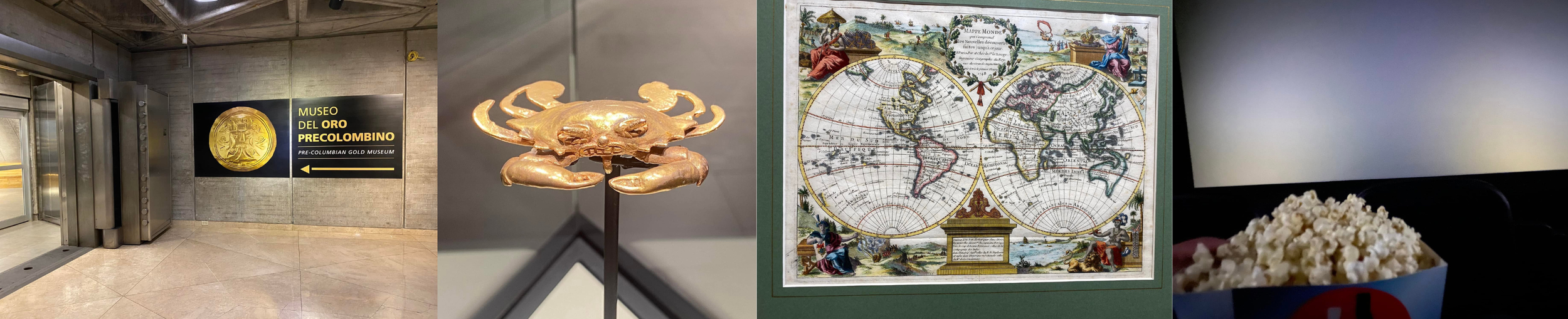
Ancient gold, centuries-old maps, and popcorn for Uncharted—an unexpectedly fitting end to my final full day in Costa Rica.
Enjoyed this story? Toss a tip in the jar—thanks for reading.
Continue Exploring Costa Rica
Costa Rica Travel Guide & Tips
Top 10 Places to Visit in Costa Rica
Costa Rica Story #1: My first Days in Costa Rica
Costa Rica Story #2: Three Days in Tamarindo: Three Hostels, an ATV Tour, and New Beginnings
Costa Rica Story #3: Three Weeks in Cabuyal: Volunteering with Sea Turtles in Costa Rica
Costa Rica Story # 4: Monteverde: Costa Rica's Misty Cloud Forest
Costa Rica Story #5: Sloths, Volcanoes, and Hot Springs: My 2 Days in La Fortuna
Costa Rica Story #6: Jacó: Two Nights of Sunsets, Rum, and Slowing Down
Costa Rica Story #7: Manuel Antonio: Beaches, Jungle Trails, and a Monkey Thief
Costa Rica Story #8: Puerto Viejo: Missed Plans, Unexpected Visitors, and Extra Beach Days
