Sloths, Volcanoes, and Hot Springs: My 2 Days in La Fortuna
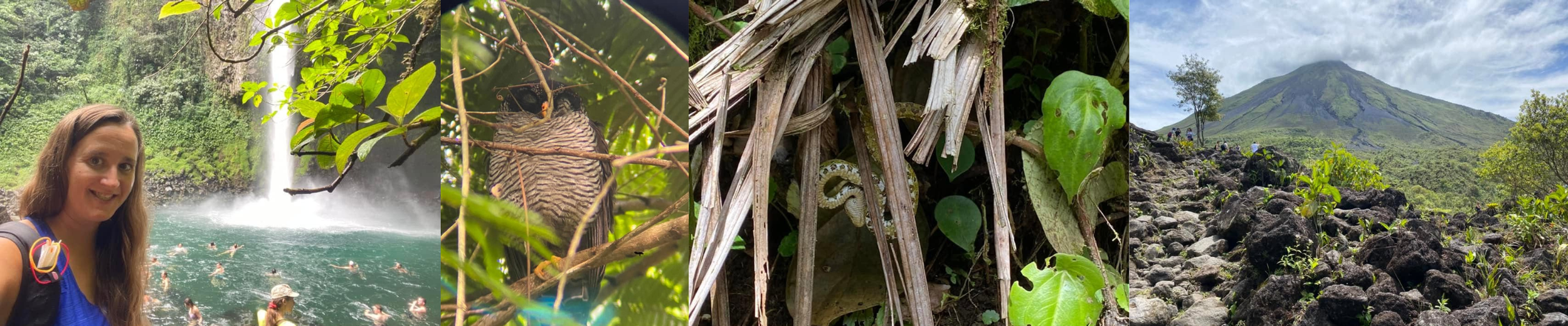
From waterfalls and wildlife to lava fields and Arenal Volcano, La Fortuna was packed with unforgettable experiences.
From the Cloud Forest to the Volcano
After spending a few incredible days exploring the misty cloud forests of Monteverde, it was time to head to one of Costa Rica's most famous destinations - La Fortuna. Home to the iconic Arenal Volcano, waterfalls, hot springs, and an abundance of wildlife, it had been high on my list ever since I started planning my trip.
Unlike many journeys through Costa Rica, getting there was part of the adventure.
Early that morning, I climbed into a shuttle van packed with fellow backpackers and began the drive out of Monteverde. Rather than taking the long road around Lake Arenal, our driver dropped us at the lakeshore, where we boarded a boat to cross the water instead. It was an interesting way to travel and one I hadn't experienced before. Looking back, I'm pretty sure it saved us hours of driving while also giving us some beautiful views across the lake.
On the opposite shore, another shuttle was waiting to collect everyone before continuing the journey into La Fortuna. It felt like a well-organized relay race - one shuttle, one boat, then another shuttle - moving dozens of travellers between two of Costa Rica's most popular destinations.
A short while later, I arrived at Arenal Poshpacker, my home for the next two nights. I had chosen it mostly because of its swimming pool—after weeks of travelling, having somewhere to relax at the end of a busy day sounded pretty appealing. Its location in the centre of town was another bonus, making it easy to walk almost everywhere I wanted to go.
After checking in, my first priority was booking a full-day tour for the following day. I settled on one that included La Fortuna Waterfall, Arenal Volcano, lunch, and the famous natural hot springs—a perfect introduction to everything the region is known for.
With that sorted, there was only one thing left on my agenda.
If there was one animal I desperately wanted to see in Costa Rica, it was a sloth.
Everything I had read online pointed to one place as the best chance of finding them in the wild: Bogarin Trail. I wasn't about to waste the opportunity, so I set off on foot, hoping that La Fortuna was about to deliver one of the wildlife experiences I'd been dreaming about.

Relaxing by the pool at Arenal Poshpacker after an unforgettable day exploring La Fortuna.
Meeting Costa Rica's Most Famous Residents
Before arriving in Costa Rica, I'd read countless blogs and travel forums claiming that La Fortuna was one of the best places in the country to spot them in the wild. One place kept appearing over and over again: Bogarin Trail. Without giving it much more thought, I set off on foot, excited to see if the internet was right.
The entrance surprised me. Instead of feeling like a national park, it looked polished and well-maintained, almost like a private nature reserve. As I later learned, that's because it actually is privately owned.
Admission cost me US$20, and after a quick look around I decided to spend another US$20 to hire a guide. It turned out to be one of the best decisions I made during my entire time in Costa Rica.
There were only five of us in the group—myself and two other couples—which made the experience feel much more personal. Our guide carried a spotting scope, and within minutes it became obvious why hiring a guide was worth every dollar. Sloths are experts at blending into the trees. Even after the guide pointed directly at one, I often struggled to find it with my own eyes. Looking through the telescope completely changed the experience, allowing us to see their faces, claws, and surprisingly expressive features.
Without a guide, I honestly think I would have left believing there was only one sloth in the entire park.
Instead, we found several.
The highlight came when a mother sloth and her baby slowly climbed through the trees above us. Watching them move so deliberately from branch to branch was incredible. They certainly don't move quickly, but that's part of their charm. Standing there watching them in complete silence became one of my favourite wildlife moments in all of Costa Rica.
The sloths weren't the only animals we found, either. Our guide somehow managed to spot a tiny green-and-black poison dart frog hidden among the leaf litter beside the trail. Even after she pointed it out, I nearly walked straight past it. It was another reminder that guides don't just help you identify wildlife—they help you see things you would never notice on your own.
As we continued walking, I found myself asking question after question. One fact that really surprised me was that sloths only climb down from the trees about once a week to go to the bathroom. Considering how much time they spend high in the canopy, I never would have guessed that.
But the wildlife wasn't the only fascinating thing I learned that morning.
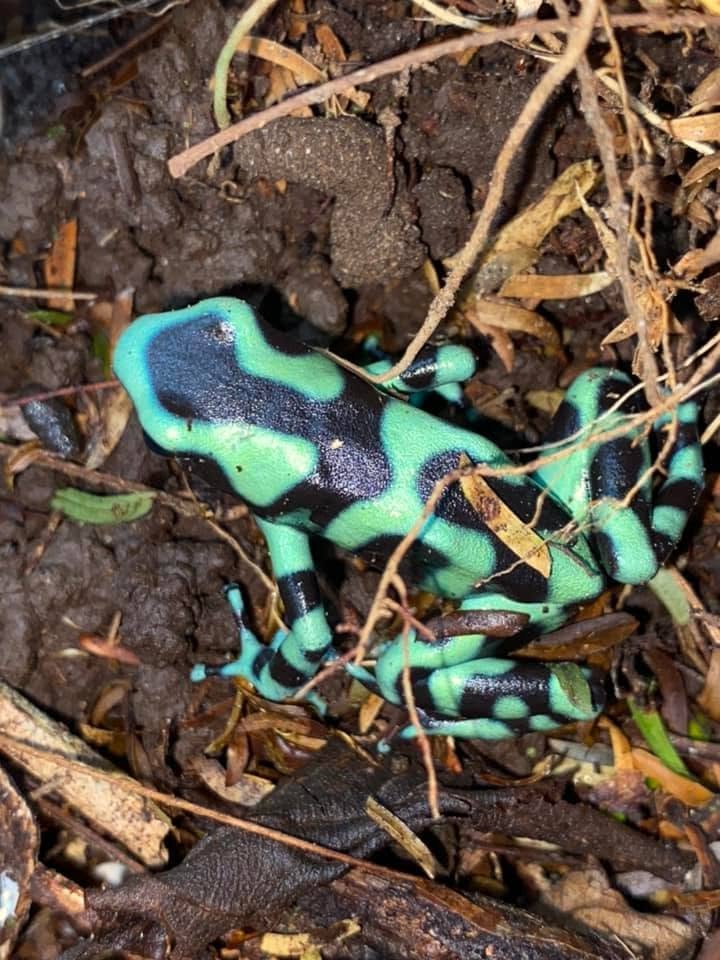
Our guide somehow spotted this tiny green-and-black poison dart frog hiding among the forest floor. I would have walked right past it on my own.
Our guide explained that Bogarin Trail hadn't always looked like this. Years ago, it was farmland with very little wildlife. Costa Rica has become one of the world's greatest conservation success stories, thanks in part to a government program that pays landowners to protect and restore forests instead of clearing them. Rather than cutting down trees, landowners can actually earn money by preserving them.
A man approached the owner of this property with an idea. He asked if he could plant native trees that would attract wildlife, while sharing some of the government conservation payments. The landowner agreed, probably never imagining what would happen next.
Year after year, the forest slowly returned.
As the trees matured, the wildlife came back naturally. Sloths arrived on their own. Birds followed. Frogs, reptiles, insects, and countless other species moved in without anyone bringing them there. During my visit, they had even begun planting an area specifically designed to attract hummingbirds.
Eventually, the landowner realized the restored forest had become more valuable as a wildlife sanctuary than it had ever been as farmland. Today, visitors from around the world come to Bogarin Trail hoping to see the very animals that chose to make this forest their home.
I loved that story because it showed how conservation can benefit both wildlife and local communities. Instead of protecting nature by keeping people out, Bogarin Trail demonstrated that restoring habitats could create jobs, educate visitors, and give wildlife a safe place to thrive.
The guided walk lasted about two hours, and by the time it finished, I couldn't stop smiling. Before leaving, we were treated to some fresh fruit, giving everyone a chance to chat about our favourite sightings from the tour. It had been everything I'd hoped for and more.
One thing I really appreciated was that admission included the option to return within 24 hours, as long as you kept your wristband on. I had hoped to come back the following day to see what other wildlife I could find, but with my full-day volcano tour already booked, I simply didn't have enough time before it was time to leave La Fortuna.
Still, I couldn't complain.
I had come to La Fortuna hoping to see a sloth.
Instead, I left Bogarin Trail with a much deeper appreciation for the remarkable conservation work happening across Costa Rica—and one of my favourite wildlife experiences of the entire trip.
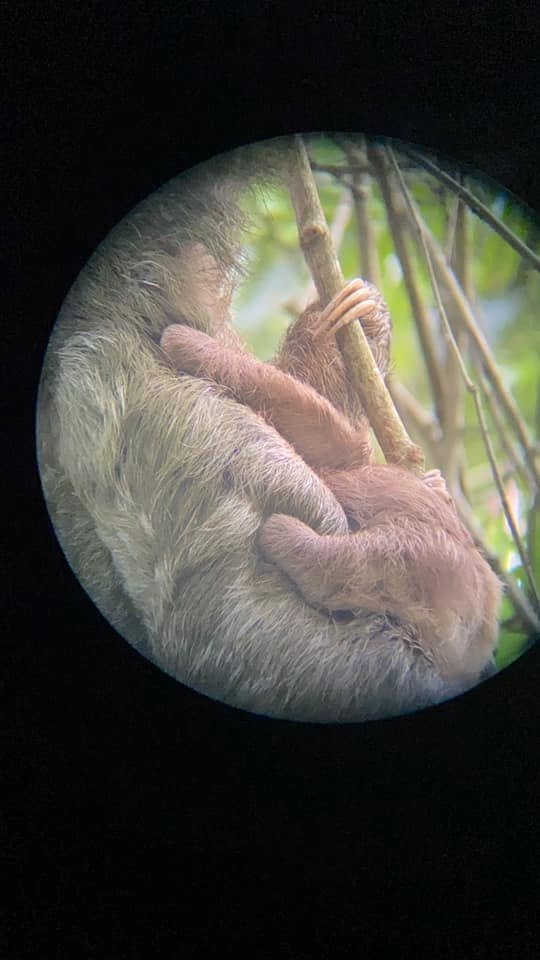
Seeing a mother sloth and her baby in the wild made the entire visit to Bogarin Trail unforgettable.
A Full Day Around Arenal Volcano
The next morning started early as I climbed aboard another small tourism shuttle, ready for a full day exploring everything the Arenal region is famous for. Our itinerary included La Fortuna Waterfall, Arenal Volcano, lunch, and the natural hot springs. It was going to be a busy day, but I couldn't wait to get started.
Our first stop was La Fortuna Waterfall, and before we even reached it, I had my first wildlife surprise of the day.
High in the trees were a pair of toucans.
Unfortunately, they were too far away for me to get a decent photograph, but I didn't care. Seeing toucans in the wild had been high on my Costa Rica wish list, and simply standing there watching them hop between the branches was enough to make my morning.
To reach the waterfall, we had to make the long journey down what felt like an endless staircase. Thankfully, the walk was broken up by signs displaying inspirational quotes about nature and life, giving everyone an excuse to stop, catch their breath, and admire the rainforest around us.
When we finally reached the bottom, the waterfall was every bit as impressive as I'd imagined. Water thundered into the bright blue pool below, surrounded by lush rainforest in every direction. It was easy to see why it's one of Costa Rica's most photographed waterfalls.
Like many popular attractions, though, it was also busy. Plenty of visitors were swimming beneath the falls while others searched for the perfect photo. I dipped a toe into the water, quickly discovering just how cold it was, and decided that was enough swimming for me.
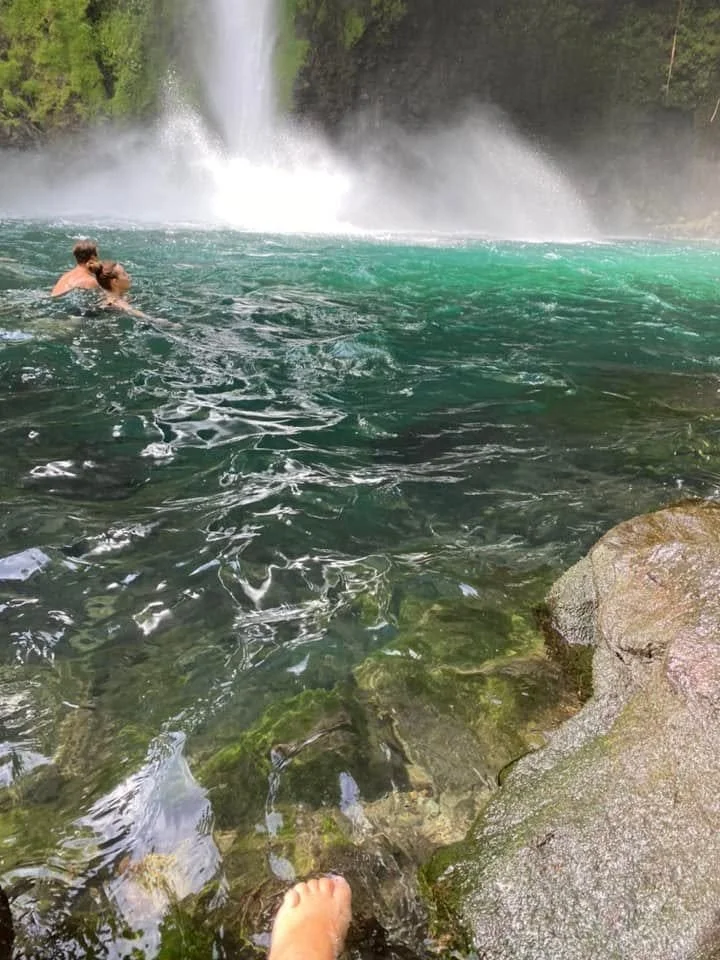
I quickly discovered just how cold the water was... one toe was enough for me!
From there, we continued towards Arenal Volcano.
One thing I hadn't realised before visiting was that you can't actually hike to the summit of the volcano. Following the major eruption in 1968, much of the surrounding area became protected, and the hiking trails that visitors use today are located on private properties around the volcano or within designated protected areas. These trails still offer incredible views while helping preserve the landscape.
Our guide explained how the eruption dramatically changed the region, covering parts of the surrounding landscape in lava and volcanic rock. Even today, you can still see massive fields of dark volcanic boulders scattered across the area, a reminder of just how powerful Arenal once was.
The hike itself wasn't particularly difficult, but the tropical heat certainly made it feel longer.
There were more than a few moments when I found myself wondering why I willingly signed up to hike in the middle of the day.
Luckily, our guide kept stopping to point out interesting plants, wildlife, and viewpoints, giving everyone a chance to catch their breath.
At one point, he suddenly motioned for us to stop.
Lying almost perfectly camouflaged among the fallen palm fronds beside the trail was a snake. Had he not pointed it out, every single one of us would have walked straight past it without ever knowing it was there. Moments like that reminded me once again just how valuable local guides are. They notice details that most visitors would never see on their own.
Eventually, we reached one of the viewpoints overlooking Arenal Volcano.
Standing there, surrounded by old lava fields with the volcano towering above us, it was easy to imagine how dramatically this landscape must have changed during the 1968 eruption. Thankfully, Arenal has been in a resting phase since 2010, but seeing it up close was still incredibly impressive.
After our hike, we headed for a well-earned lunch. I chose carne with rice and beans, a simple but delicious meal that tasted even better after spending the morning exploring in the heat.
Nearby was a small swimming area where anyone who wanted could cool off. The water looked a little murky to me, so I decided to stay on dry land instead. While waiting, I noticed the shallow edges were full of tiny tadpoles, another reminder that wildlife seemed to be everywhere in Costa Rica if you slowed down long enough to look.
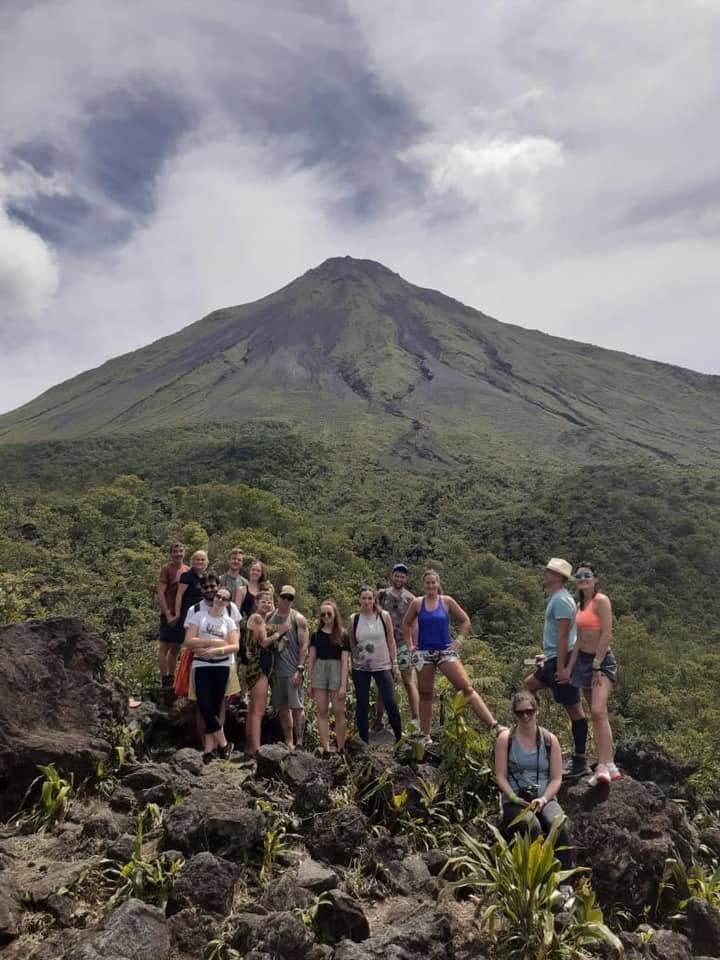
Standing at the base of Arenal Volcano—it was incredible to finally see one of Costa Rica's most iconic landmarks up close.
Our final stop was the natural hot springs, one of the experiences I had been looking forward to the most.
Unlike the luxury hot spring resorts nearby, these pools were completely natural and free to visit, making them popular with both locals and tourists. By the time we arrived, the river was already packed with people trying to squeeze into the warmest sections.
I eventually found a small spot to sit back and enjoy the water. What surprised me most was how the temperature constantly changed. One moment, a stream of wonderfully warm water would flow over you, and the next it would be replaced by a much cooler current. Personally, I found myself wishing the water was a little hotter, but after a long day of hiking, it was still the perfect place to relax before heading back to town.
By the time our shuttle dropped everyone back at their hotels that evening, I was completely exhausted—but in the best possible way. It had been one of those days where every stop offered something different, from waterfalls and volcanoes to wildlife and hot springs, making it easy to understand why La Fortuna is one of Costa Rica's most popular destinations.
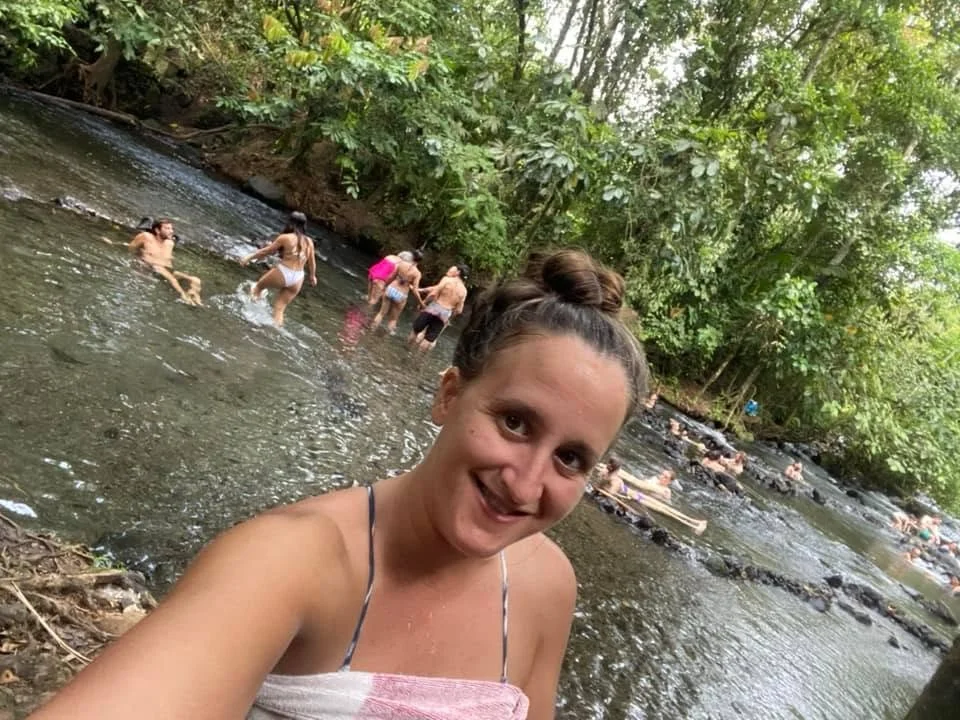
Relaxing in the free natural hot springs after a full day exploring the Arenal region.
Why La Fortuna Lived Up to the Hype
By the time I got back to Arenal Poshpacker, I was exhausted.
The hostel's swimming pool looked incredibly inviting after spending the entire day hiking, climbing stairs, and soaking in the hot springs, but as soon as I sat down, I realized I was actually cold. Instead of jumping in, I found myself relaxing beside the pool for a while before heading off for a much-needed shower.
That evening, I didn't do much at all.
After two days packed with wildlife encounters and outdoor adventures, an early night sounded far more appealing than exploring the town. I crawled into bed knowing another travel day awaited me in the morning.
Looking back, La Fortuna completely lived up to its reputation.
Before arriving, I knew it was famous for Arenal Volcano, waterfalls, hot springs, and sloths. What I didn't expect was how much I would learn during my time there. From discovering Costa Rica's incredible conservation efforts at Bogarin Trail to learning about the history of Arenal Volcano and seeing wildlife around almost every corner, I left with a much deeper appreciation for the region than I expected.
Of course, the highlight for me was seeing the sloths.
Watching a mother and her baby slowly move through the trees is a memory I'll never forget, and hiring a guide turned out to be one of the best decisions I made. Without their knowledge and spotting scope, I would have missed almost everything that made Bogarin Trail so special.
La Fortuna also reminded me why I enjoy guided tours every now and then. Normally, I prefer exploring independently, but having local guides share stories, point out hidden wildlife, and explain the history behind the places I was visiting added so much to the experience. It's one thing to admire a beautiful landscape, but it's another to understand the stories that shaped it.
After two unforgettable days, it was time to pack my backpack once again.
My next stop would take me from Costa Rica's volcanic interior to the Pacific coast. After several busy days filled with hiking, wildlife, and tours, I was ready for a slower pace, a beach, and some time to relax.
Next up: Jacó.
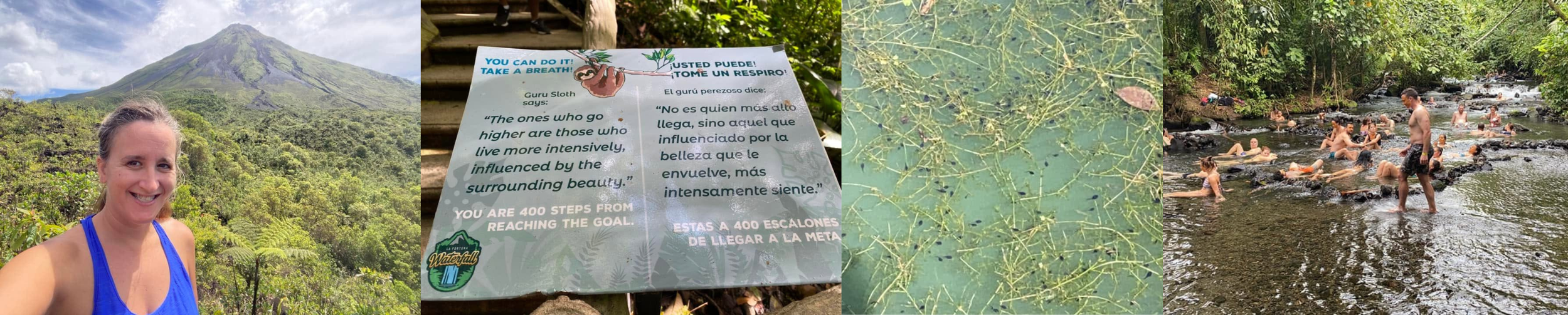
Some of my favourite moments from two unforgettable days in La Fortuna.
Enjoyed this story? Toss a tip in the jar—thanks for reading.
Continue Exploring Costa Rica
Costa Rica Travel Guide & Tips
Top 10 Places to Visit in Costa Rica
Costa Rica Story #1: My first Days in Costa Rica
Costa Rica Story #2: Three Days in Tamarindo: Three Hostels, an ATV Tour, and New Beginnings
Costa Rica Story #3: Three Weeks in Cabuyal: Volunteering with Sea Turtles in Costa Rica
Costa Rica Story # 4: Monteverde: Costa Rica's Misty Cloud Forest
