Wildtracks & Beyond: My Belize Adventure from Manatees to Mayan Ruins
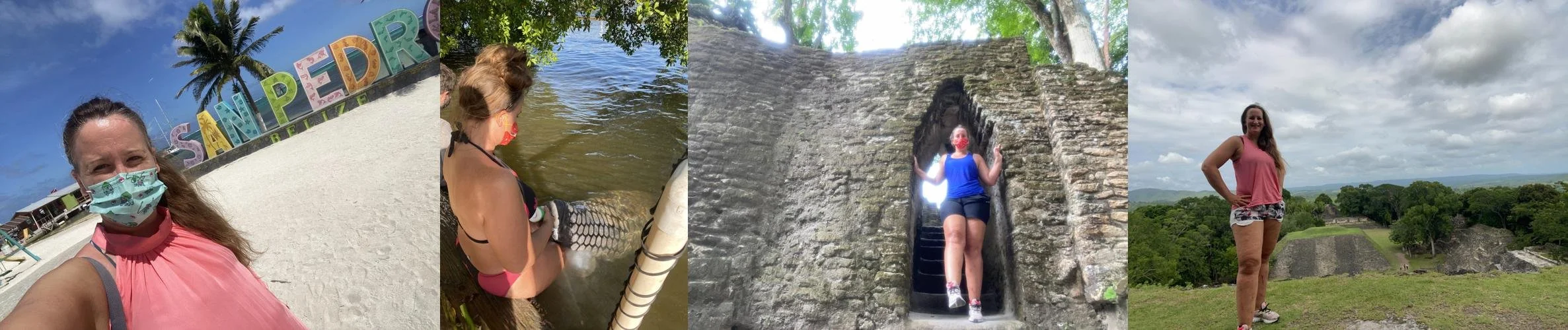
From the islands to the jungle — San Pedro sunsets, manatee care at Wildtracks, and ancient Maya ruins at Cahal Pech and Xunantunich.
My last morning in San Pedro started slow.
After days of packing, last sightseeing in Hong Kong, saying goodbye to friends, and surviving nearly 36 hours of travel, I was finally rested. I packed my bag, slipped on my bathing suit, and headed to lunch at a small restaurant right on the ocean. They served food and drinks on a wooden deck, and after eating my quesadilla and a rum and Coke — comfort food before volunteering life began — I climbed down to the water and floated on one of their inner tubes.
I wanted to enjoy as much western food as possible while I still could; I had no idea what meals awaited at Wildtracks or when I’d next find anything cheesy again. It was the perfect way to spend my final hours on the island before catching the 2 p.m. boat to Sarteneja. I wasn’t tired anymore — just calm, relaxed, and ready for whatever came next.
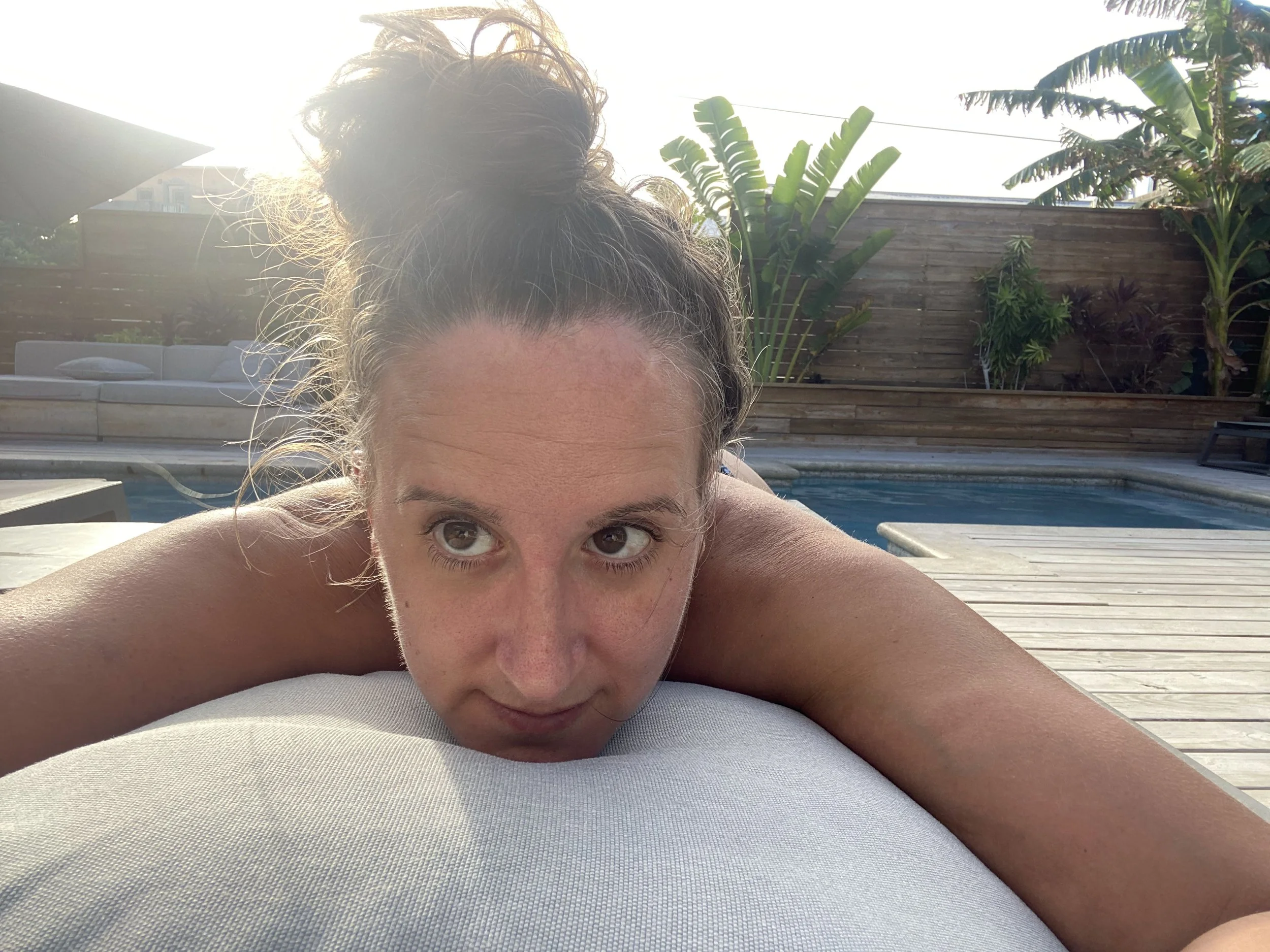
Soaking up the sunshine and island calm — a well-earned moment of relaxation in San Pedro.
The Road to Wildtracks
When the ferry docked, I met Dion, a friendly local man waiting with an old pickup truck that looked like it had a lifetime of stories. We loaded my bags into the back and set off down a quiet, bumpy dirt road through Sarteneja.
The drive was peaceful — no traffic, no voices, just the hum of the tires on gravel and the occasional birdcall. There wasn’t any ocean sound here, just the stillness of the inland air. Wildtracks is located on a lagoon, not the sea, and the silence there felt absolute.
After nearly an hour, we arrived. The sunlight reflected off the calm water, palm trees rustled overhead, and for the first time in a long while, everything felt still. After two years in Hong Kong, the quiet was exactly what I needed.
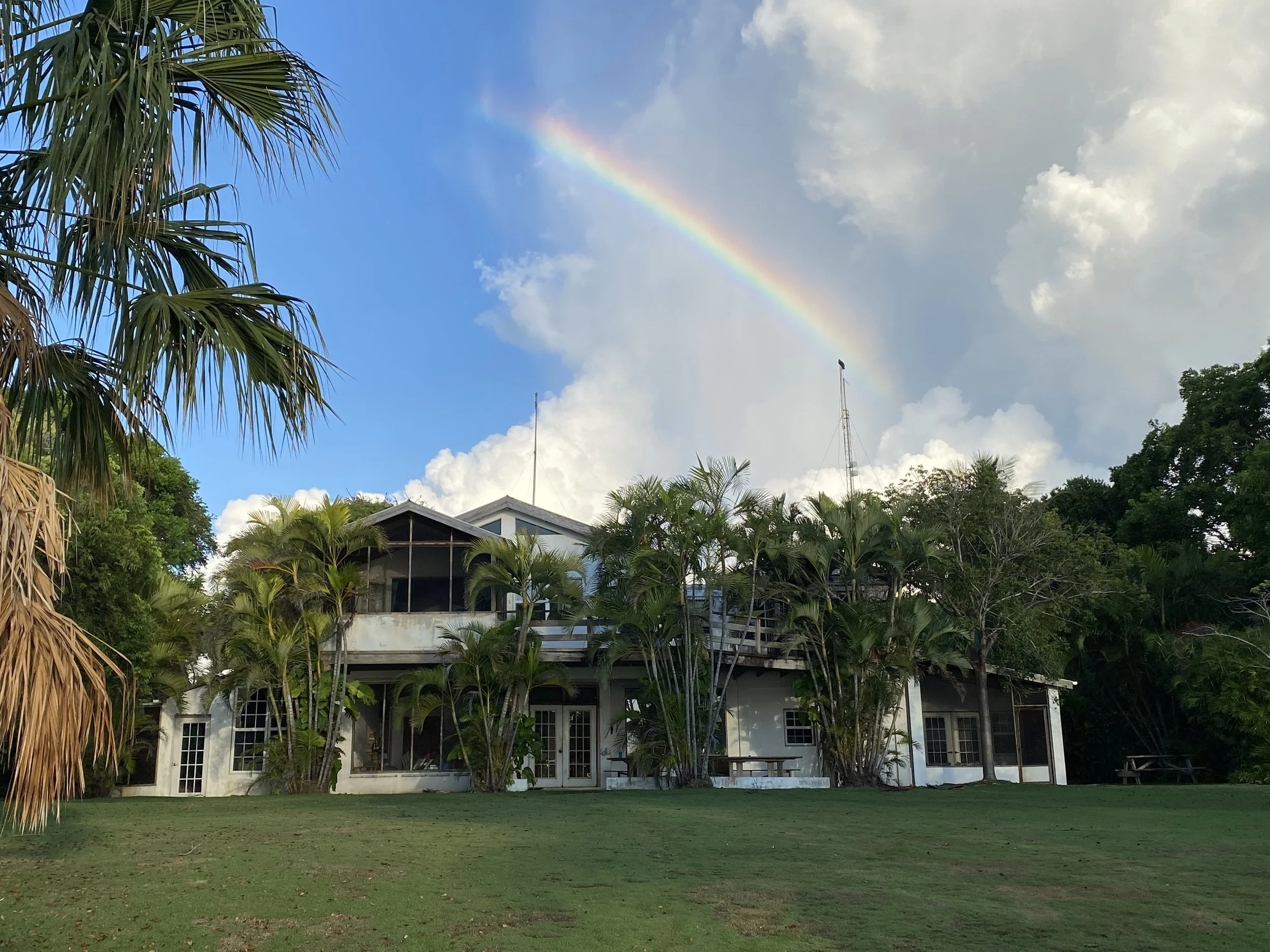
A rainbow over the main house at Wildtracks — the perfect symbol for hope and second chances.
Life at Wildtracks
Wildtracks is a small but extraordinary wildlife rehabilitation center near the quiet fishing village of Sarteneja. It’s tucked away on a lagoon, surrounded by mangroves and jungle — the kind of place where time slows down and the loudest sounds are howler monkeys just a few hundred meters away. Boy, are they loud — they sound straight out of Jurassic Park!
I was greeted by the founders, Paul and Zoe, along with a few volunteers finishing up chores for the day. My roommate, Lara from the UK, showed me around our hut — two beds, a bathroom, and no electricity. If we wanted Wi-Fi or to charge anything, we had to walk to the main house. It was the perfect digital detox I didn’t know I needed.
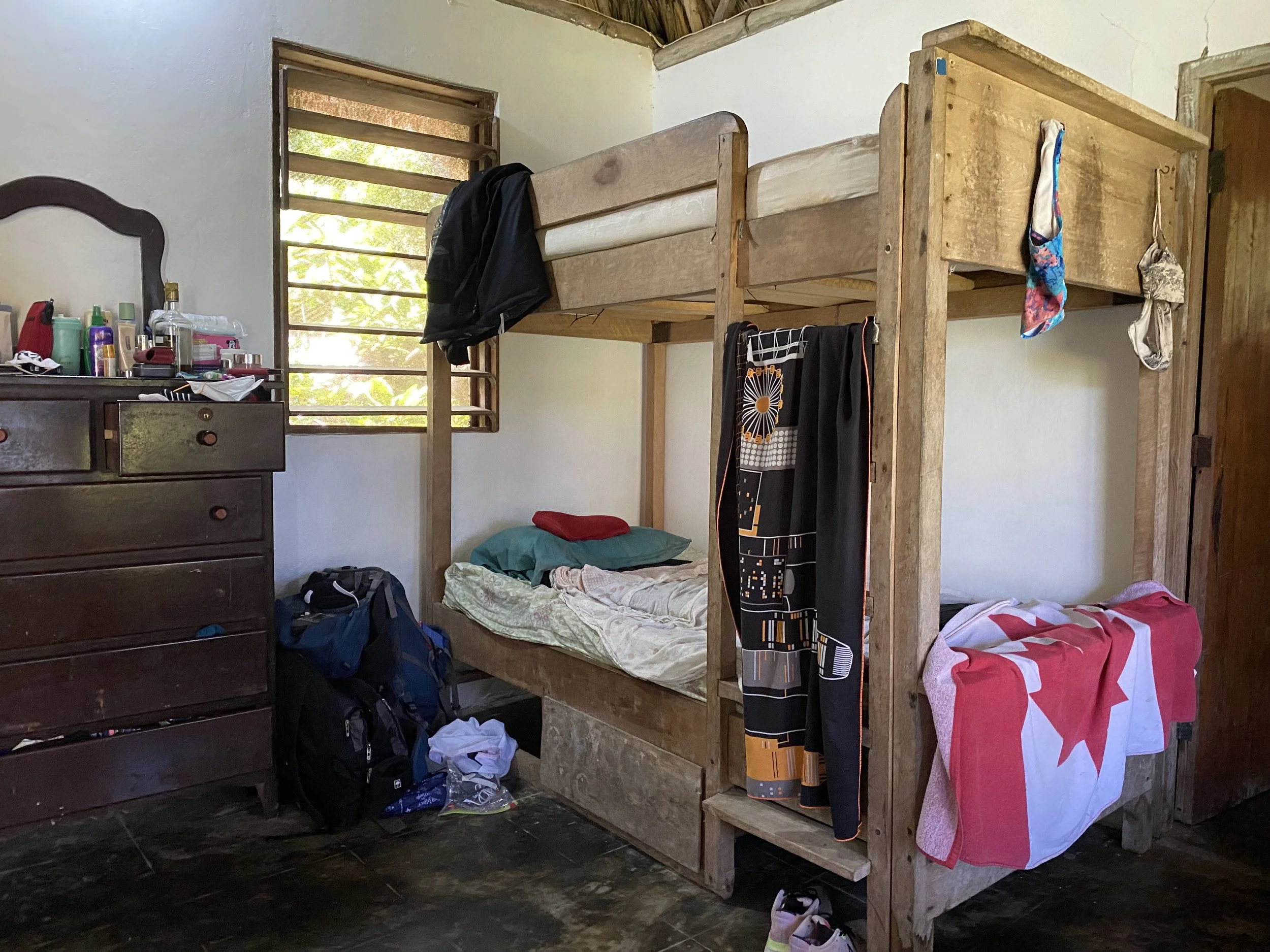
Volunteer housing at Wildtracks — where the real adventure begins each morning.
The next morning began with orientation — safety, conservation, and how manatees and monkeys arrive at Wildtracks. I officially joined the Manatee Team, where I helped care for six manatees: four “big girls” — Callie, Sally, Chiki, and Hope — and two playful babies, Teek and Nugget. Each had its own personality: Sally was the sweetheart, Chiki the gentle giant, and Nugget the mischievous one who loved to wrap herself around your leg during feeding time.
Days started before sunrise and followed a steady rhythm — baby bottles at dawn, seagrass collection by kayak in the heat, bird feedings, and evening check-ins at the lagoon. There were mosquito bites, saltwater bucket showers, and a few leaky kayaks, but somehow it all felt exactly right.
Every Friday night, Dion — the same driver who picked me up on my first day — would pile us into the back of his truck and take us into Sarteneja for dinner. Chicken nuggets, fries, and laughter under a sky full of stars became our weekly tradition.
I originally planned to stay one month, but forty days later, I was still there — helping wherever I could and not quite ready to leave.
Wildtracks reminded me why I fell in love with marine biology in the first place: it’s not glamorous, but it’s meaningful. Standing knee-deep in lagoon water beside a rescued manatee, I felt the quiet satisfaction that comes from helping without expectation — just the simple joy of giving back to nature.
If you’d like to learn more about my time at Wildtracks — the daily routine, the incredible manatees, and one very memorable missing tracker — you can read my full Wildtracks blog or watch the videos on my YouTube channel.
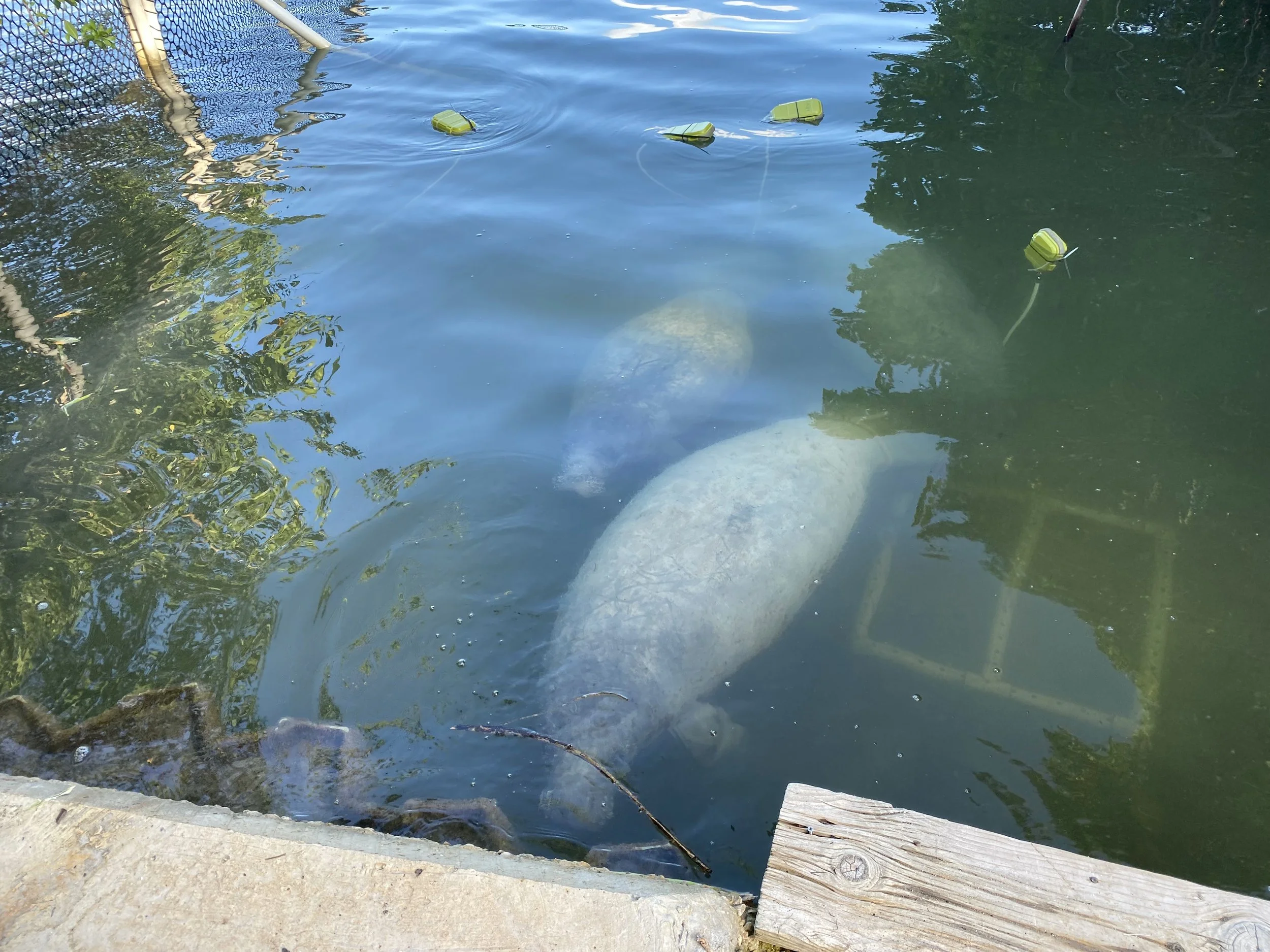
My daily audience — four hungry manatees ready to eat.
Moving On
Eventually, though, it was time to go. I had made plans to meet my best friend Bryce in Guatemala for his birthday. I would have happily stayed longer, but new countries were waiting.
Each morning, Dion dropped off local workers at Wildtracks before heading back into town, so I hitched a ride with him to the bus station. We waved goodbye, and I climbed aboard a chicken bus bound for Belize City.
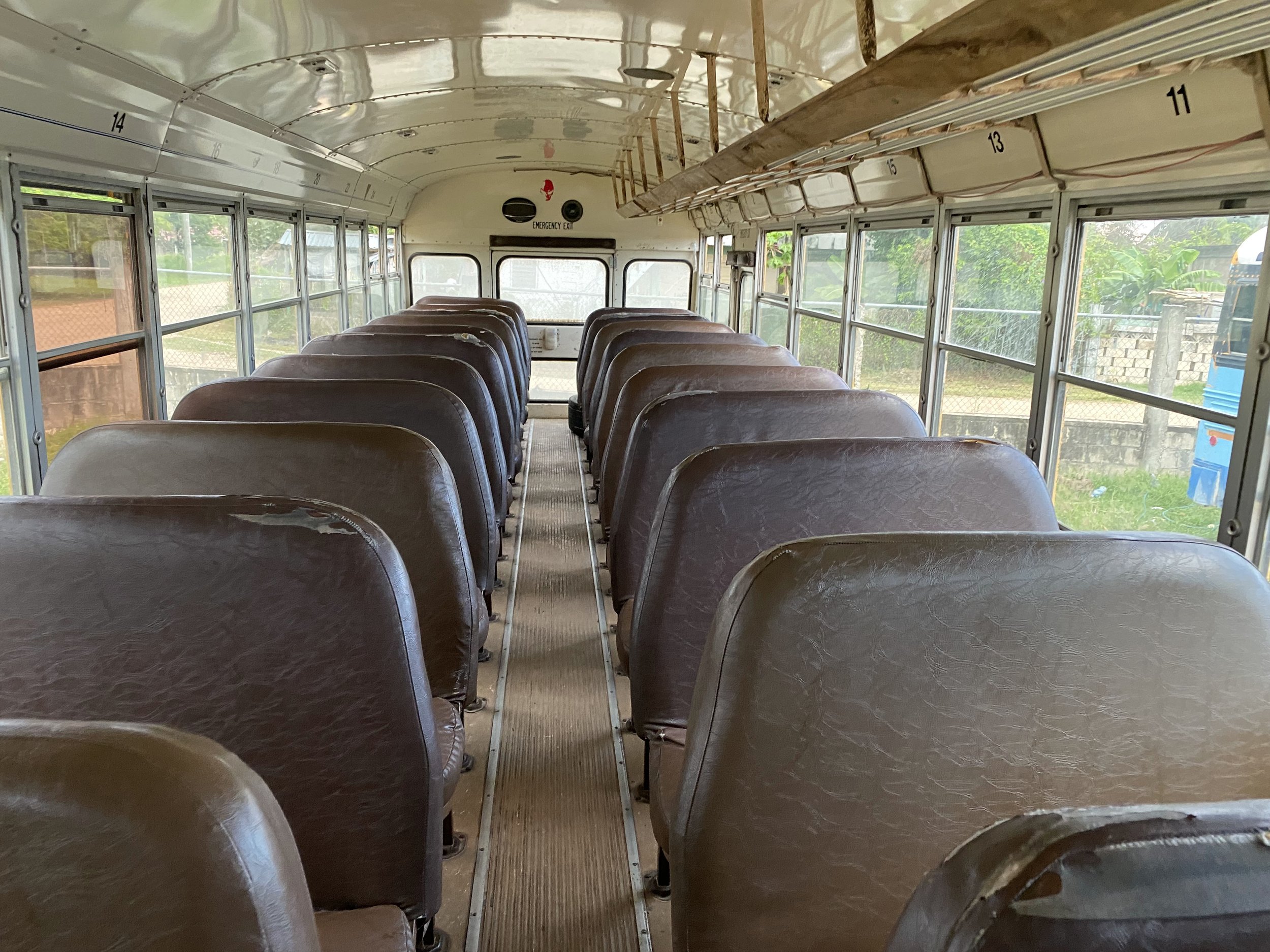
Leaving Wildtracks behind and hopping on the bus to my next adventure — bittersweet goodbyes and new beginnings ahead.
A Night of Luxury
After forty days of bucket showers and mosquito nets, stepping into a hotel room felt like a dream. I took the longest hot shower, ordered a burger and fries, and stretched out on a big, comfy bed with clean sheets and real electricity. I watched TV all night long — something I hadn’t done in months — and smiled at the simple pleasure of it.
I even got my laundry cleaned, though it came back a little stiff and nowhere near as fresh-smelling as the sun-dried clothes at Wildtracks. Still, it felt good to have clean clothes, hot water, and quiet. That night, I slept better than I had in ages.
The Road to San Ignacio
The next morning, I grabbed a taxi to the bus station and boarded another chicken bus to San Ignacio, a lively town close to the Guatemalan border. The ride wasn’t crowded or loud, but every so often, locals would hop on to sell snacks and drinks — bags of sliced mango, bottles of juice, or small pastries passed down the aisle.
When I arrived, I was ready to explore. My hostel, Bella’s Backpackers, was nearly empty, and I had the place mostly to myself. I asked about tours, but since I was the only guest, nothing was running. So that evening, I walked up to the nearby Cahal Pech Mayan Ruins on my own.
Cahal Pech, perched on a hill overlooking San Ignacio, was once a royal palace for an elite Maya family. Its name means “Place of the Ticks” — though thankfully, I didn’t encounter any. I wandered through ancient plazas, narrow stone passages, and overgrown courtyards, imagining what daily life must have looked like centuries ago. The late afternoon light cast long shadows across the moss-covered walls, and for a moment, it felt like time had stopped.
I didn’t see any wildlife, but I spent a couple of hours exploring until closing time, taking photos and soaking in the peace. On the way back, I stopped at a small grocery store and grabbed a few supplies — including a box of mac and cheese for dinner.
I turned in early, ready for another early start.
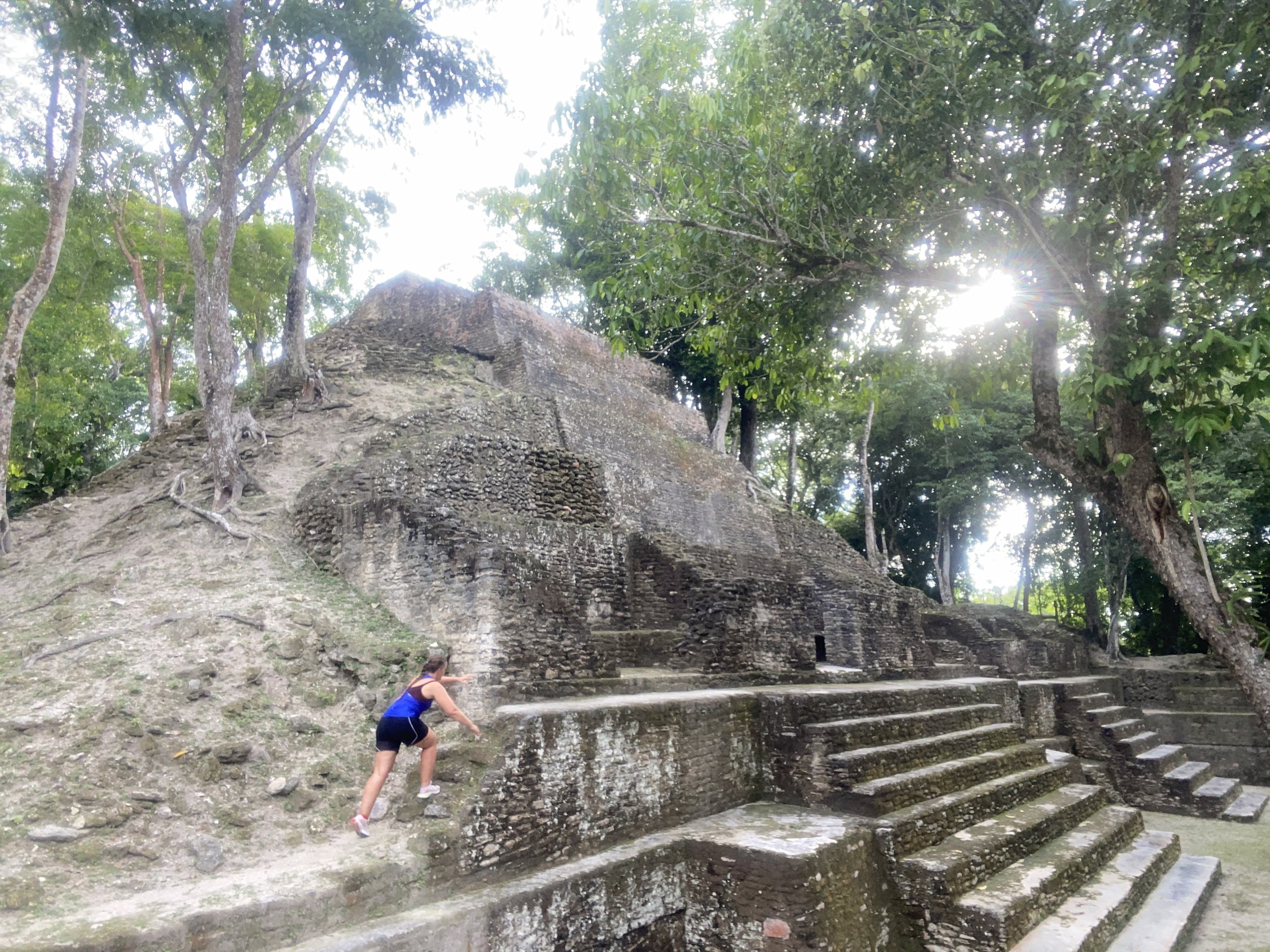
Exploring the ancient Maya site of Cahal Pech — where every stone tells a story.
Xunantunich
At sunrise, I caught a local bus headed toward Xunantunich, determined to be there when it opened. The bus dropped me off near the river, where I crossed on a small hand-cranked ferry that slowly pulled us to the other side — it felt like stepping back in time. From there, it was about a fifteen-minute walk to the ticket office, a peaceful stretch lined with trees and birdsong.
Halfway there, I looked up and saw several birds flying overhead — long beaks glinting in the sunlight. I’m pretty sure they were toucans (give it to me — they had the long beaks like toucans). I tried to snap a photo, but they flew too quickly. I was also hoping to see monkeys, but I didn’t hear or spot any. So, I was happy with my “toucans,” as I believe they were the first I’d ever seen.
Once inside, I was the first visitor of the day and had the entire site to myself. Xunantunich, which means “Stone Lady”, is one of Belize’s most impressive Mayan sites. Its main temple, El Castillo, rises over 130 feet high and offers sweeping views of the surrounding jungle and the Mopan River below. Climbing to the top, I could see the misty green hills of Guatemala in the distance — a perfect reminder that my next adventure was just across the border.
I spent nearly two hours climbing temples, exploring tunnels, and taking in the view. It was one of those rare, perfect mornings that feel like a reward for every long travel day that came before it.
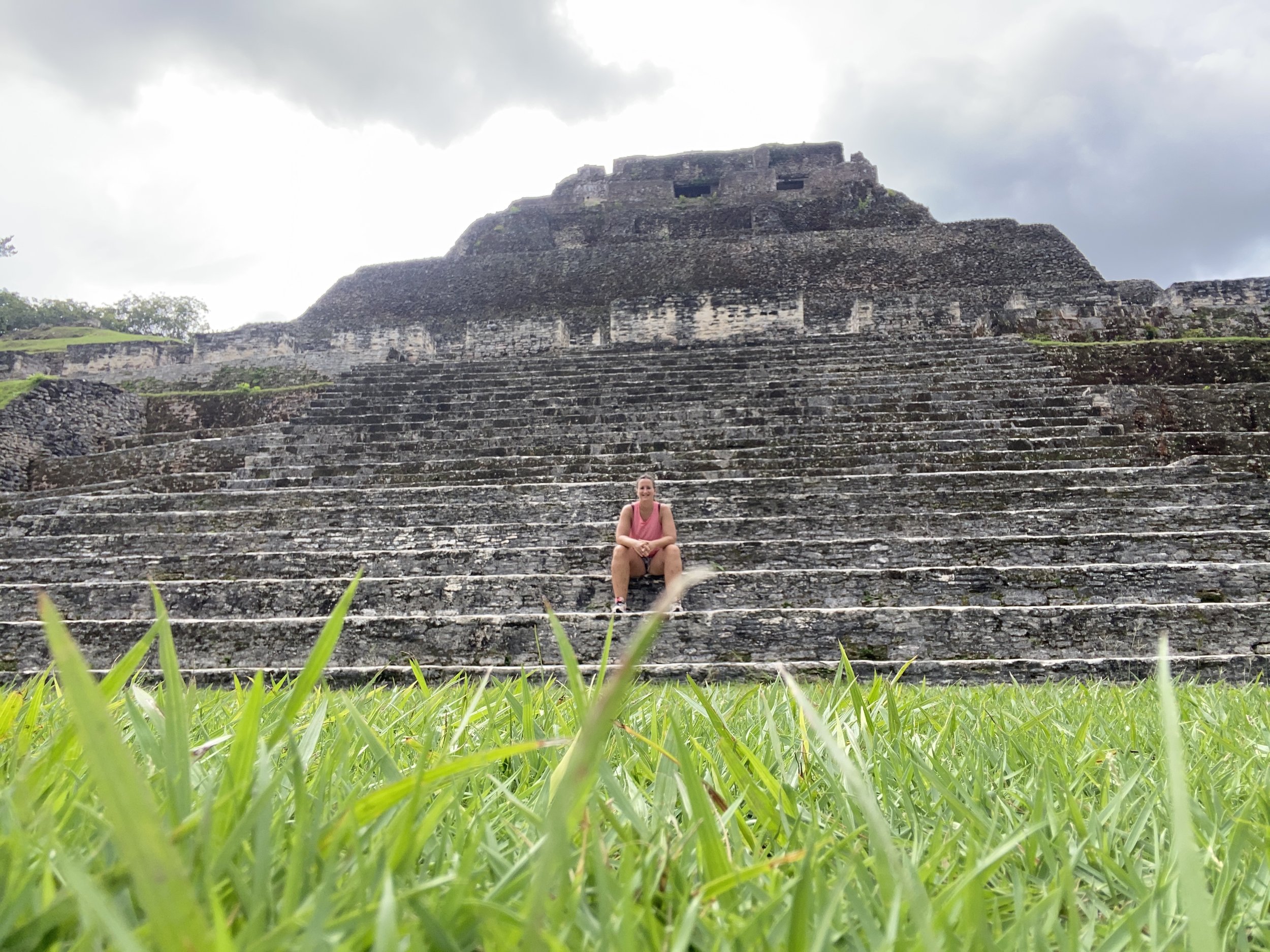
Sitting on history at Xunantunich — one of Belize’s most breathtaking Maya sites.
Crossing the Border
When I finished exploring, I walked back to the main road and waited for the bus. A few other visitors from the site were waiting too, and after a while, we collectively decided to share a taxi instead — none of us knew when the next bus would come, and the taxi would get us back to town much faster. The ride cost about $5 USD each, and the driver dropped us off in the town center.
It was a quick five-minute walk back to Bella’s Backpackers, where I grabbed my big backpack and waited for the next bus to the border. The bus took me to Benque Viejo del Carmen, the closest town before the crossing.
I’d assumed it went all the way there, but when it stopped and everyone got off, I looked around thinking, Where’s the border? A nearby taxi driver laughed and told me it was still a few minutes away — too far to walk. So, I hopped in for the short three-minute ride, which cost $5 USD. It was the same price as my much longer trip earlier, but at that point, it didn’t matter — I was leaving Belize behind.
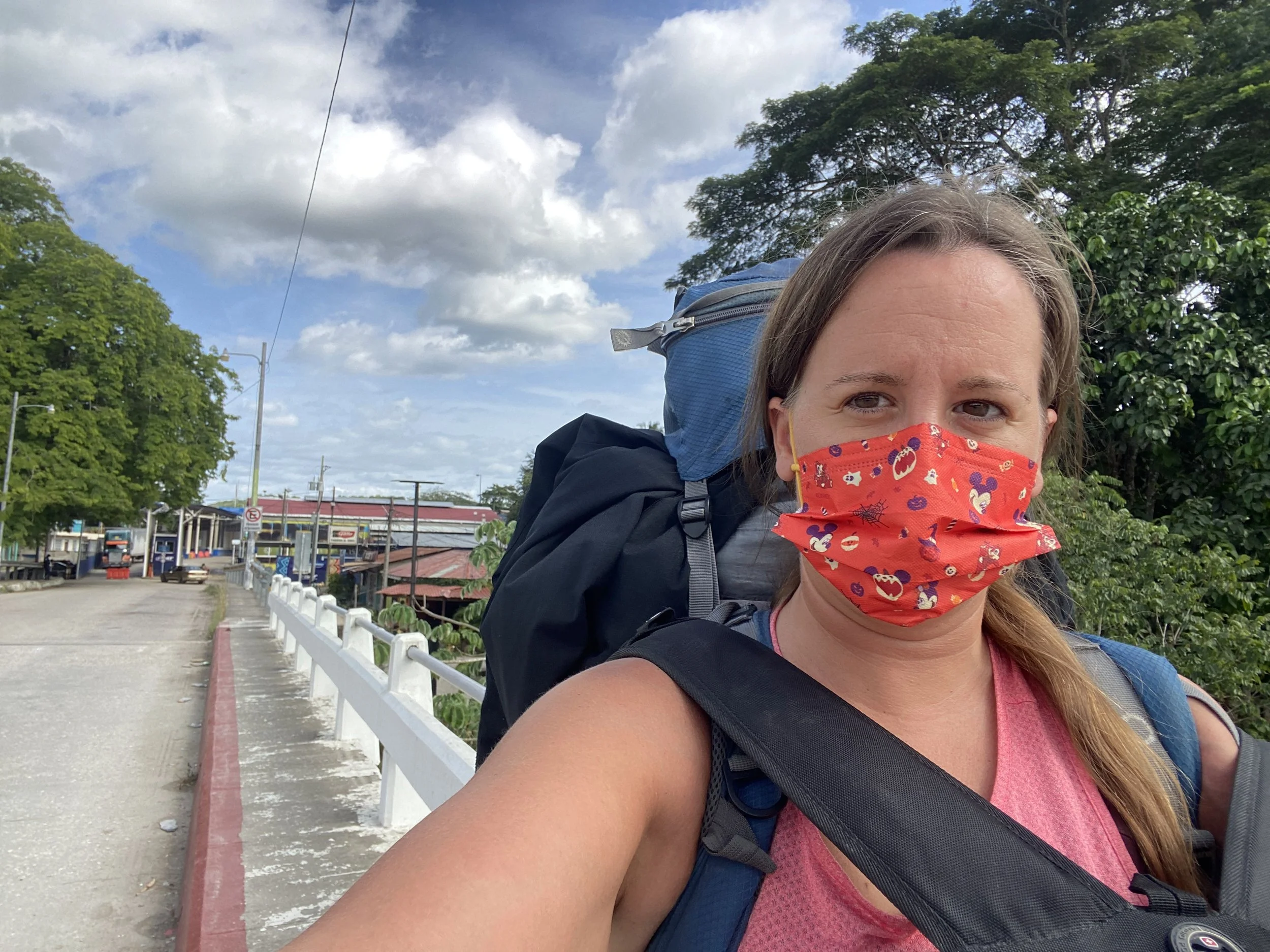
Leaving Belize behind, but taking the memories with me.
